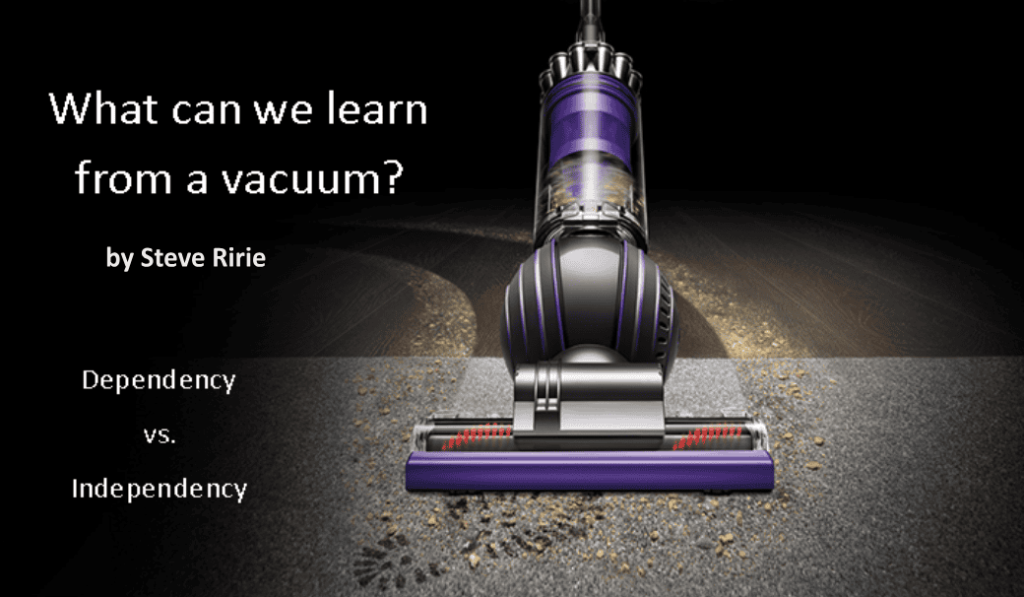
Dependency and Independency
Believe it or not, we can learn much about dependency (i.e., codependency) and independency from a vacuum! Before we delve into this metaphor, it’s vital we understand that it’s never helpful to harshly judge ourselves or others. If your thoughts go to blaming or finding fault, take a step back and consider what you can learn from a situation rather than tossing the lesson aside by casting blame. Codependency and other mental health issues are often the results of abuse, negative programming, neglect, or any number of things, and finding fault with ourselves and others only complicates healing.
For example, say you broke your arm in adolescence—a sporting accident.
Not your fault. Your injury is sure to garner sympathy from your classmates; everyone wants to sign your cast. But now, imagine being mentally or emotionally injured by abuse, neglect, or something else—not your fault either. But the injuries that come from this type of abuse are absent pretty casts for friends to sign. In place of casts are behaviors that do not garner compassion. Sadly, it is often understandable since dealing with those with mental health issues can be challenging. Remember, harsh judgment only complicates matters; forgiveness and understanding create resolution.
So what can a vacuum teach us about dependence and independence?
Well, just like a vacuum, from birth, we begin to suck in all the validation, affection, and love we can. We’re supposed to. It’s what babies do. An infant can’t be spoiled since babies need the validation that comes with love and attention. Without it, they may question the purpose of their existence. They may question their worth. Research shows that infants who do not receive love, affection, and attention suffer severe developmental disorders and, in rare cases, even death. During the formative years, from birth to puberty, we mostly suck, or take, like vacuums. Children bombard parents with cries for affection. Those from mentally and emotionally stable homes typically receive the nurturing they need, their sense of purpose and identity fostered by loving parents. They do not enter adulthood feeling an emptiness that can never be satisfied. Mentally healthy adolescents are generally caring, purposeful human beings, able to reverse the flow of the vacuum and blow (give), rather than suck (take), all the caring and love they received during their formative years. Typically, that supply lasts the rest of their lives. These people become whole and independent.
On the other hand, a child who’s neglected and abused during those formative years will often experience a gaping void, like a vacuum with an empty, leaky bag. These children tend to become dependent on others, constantly seeking the validation and affection denied them in childhood. Some turn to addictions in an attempt to curb the insatiability that comes with that emptiness.
Neglect, incidentally, is one of the most damaging forms of abuse.
Neglected children become adults who are like vacuums stuck on suck. They have inside them a black hole that’s impossible to fill. In an attempt to do so, they suck the energy from everyone around them. And just as a vacuum revs when you place your hand over the nozzle, plugging it, the craving for attention intensifies when these people can’t get it. They often become angry and passive-aggressive and look for someone else to lean on. This behavior can lead to fractured relationships.
So, how can we have a healthy relationship with a dependent person? The answer is we can’t. Healthy relationships require two mentally healthy and independent partners. Often, professional counseling is needed to break the cycle. When one or both partners are dependent, they lean on each other, enabling self-destructive behaviors, such as addiction. In this manner, they support each other’s dependency.
Envision, if you will, two dominos leaning against each other. To stand independently, one of them must stop leaning on the other. Now, the other domino must either stand or fall. If we’re honest, we can see that, like a leaning domino, our healthy relationship has already “fallen” if we are codependent. But that doesn’t mean a troubled relationship is doomed to fail.
There is hope. Stopping the dependency cycle is critical.
Again, you may require professional help to understand what that looks like in your relationship. Until things change, however, an independent partner may fear the consequences of losing their dependent partner or financial resources, or they may have other concerns, such as what might happen to the children or the termination of the relationship. At the same time, the dependent partner may be too emotionally reliant on the other to end the relationship. The relationship is codependent for both.
In a mentally healthy relationship with two independent partners, love, admiration, and respect keep those partners bound together, unlike in a relationship where the partners are emotionally dependent.
If you recognize in yourself a tendency toward dependency, you may feel hopeless.
You may say, “I’m a vacuum with a leaky bag, and I suck!” But if you can recognize your shortcomings without condemning yourself for them, you may want to know how to move from dependency to independence. I reiterate that professional help is often required here. But consider this: There is God the Father. God—spelled with a capital G. Then there are lesser gods, spelled with lowercase g’s. Children view their parents as gods (little g) because they perceive their parents as omniscient and all-powerful. And just as a god would, parents provide for a child’s physical needs. When a parent neglects or abuses a child, however, it is as if god, (lowercase g) devalues and rejects them. They receive little validation of their purpose or worth, effectively puncturing holes in their bags.
But take heart!
You can patch your bag and fill it with love and validation. You can become independent and whole. First, you must realize there is only one God—capital G. Your parents were never gods, only imperfect human beings. If you allow it, God, your eternal parent, can repair the damage, help you understand your worth, and restore your understanding of your divinity. It requires a spiritual journey to connect with Him. Only He can supply you with the love, acceptance, and validation that never fail. After all, He said, “I am the bread of life. He that cometh to me shall never hunger, and he that believeth on me shall never thirst.” – (John 6:35).
The Savior knew that some would misunderstand Him, reject His message, or simply walk away. However, I witness that there is no other way to fill the emptiness and be whole. God, with a capital G, is the perfect parent.
“Lord, I am overflowing with your blessings, just as you promised” (Psalm 119:65).
In the Old Testament, David tells God his cup is overflowing. What do you suppose he was talking about? Earthly riches? A bumper harvest or a well that provided enough water? What was it?
Whenever the Lord gives, your cup will overflow, never to be empty again. He will fill you with a sense of self-worth, purpose, and belonging, as well as His perfect love. He, and only He, can free you from your emotional dependency on others.
That’s why one of the twelve steps of Alcoholics Anonymous is connecting with God (capital G).
Without this step, the AA program would fail. So many scriptures illustrate that you must cast your burden on the Lord and hunger no more. You are a being of eternal worth. But it is one thing to read sacred scripture and another to feel it and know it in your soul. That is the journey—the spiritual journey that will fill your emptiness and make you independent. You must come to realize that your only reliance is on your Heavenly Father. There are no other gods but God! He will always love you. To feel that love, you must forgive others, starting with all gods (little g). Your parents are imperfect with their struggles, leaky bags, and shortcomings. Let go of resentment and embrace something infinitely better.
Live the life you’re meant to live, the one He wants to provide you.
For more information, see Health Realization: How People Actually Change, with George and Linda Pransky.