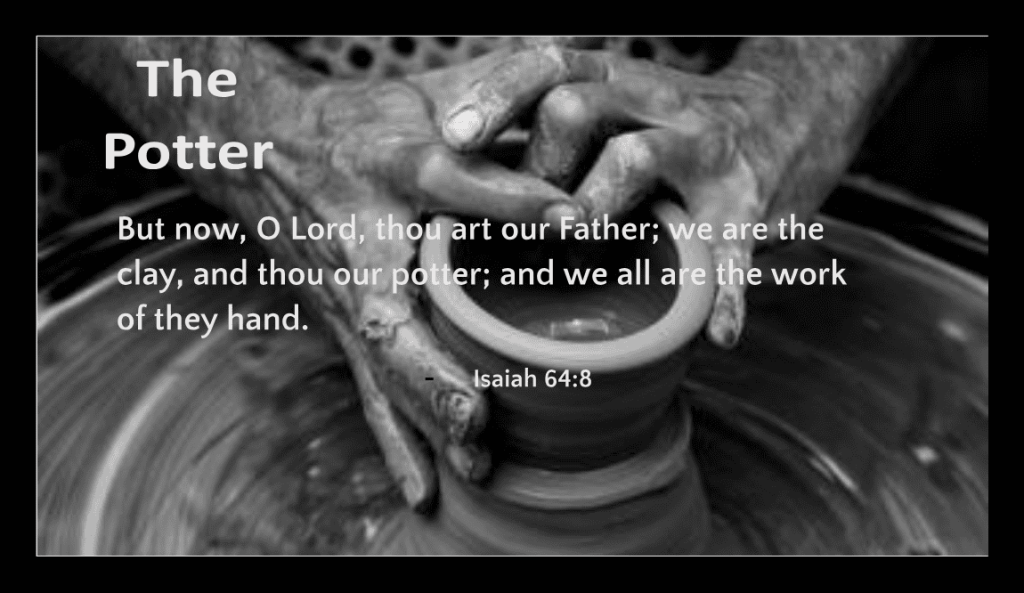
The Potter and the Clay
The Apostle Paul questioned, “Has not the Potter no right over the clay, to make out of the same lump one vessel for honorable and another for dishonorable use?” (Romans 9:21).
Does Paul suggest that God only acts upon us, thus relieving us of responsibility? Or is it that God knows us, including our weaknesses, strengths, abilities, and our capacity to endure or lack thereof? He knows what need He has of us and how we may serve Him. Yet, as the Potter’s wheel spins, we are unaware of it, living only by faith. And as the wheel and our lives turn us about, how easy it is to find fault with the Potter’s design for us.
Of his hardships, the Apostle Paul said, “Of the Jews five times received I forty stripes save one. Thrice was I beaten with rods, once was I stoned, thrice I suffered shipwreck, a night and a day I have been in the deep; in journeyings often, in perils of waters, in perils of robbers, in perils by mine own countrymen, in perils by the heathen, in perils in the city, in perils in the wilderness, in perils in the sea, in perils among false brethren; in weariness and painfulness, in watchings often, in hunger and thirst . . . in cold and nakedness. Who is not weak, and I am not weak? Who is offended, and I burn not?” (2 Corinthians 11:24–27).
Wisely, Paul remarked of such trials, “O man, who are thou that repliest against God? Shall the thing formed say to him that formed it, Why hast thou made me thus?” (Romans 9:19–20).
Can a cup tell the potter, “Why make me into a cup? A cup serves only one. Why not make me into a pitcher that may serve many?”
But how does the potter make a pitcher out of clay? A cup is easy, a pitcher much more difficult. The clay must rise to a greater height, its volume more significant. The hands of the potter must press, mold, and pull the clay into more than a simple cup. Then, the pitcher must be placed in a furnace for an extended period due to the density of the clay. But when completed, the potter can use the pitcher to serve whom he may.
If all this is true, why do we ask when life spins us about, “Why, Lord? Why these trials?” As with Paul, the more refinement we experience, the more likely the Lord is molding us into vessels who will honor Him by serving others. So, to weaknesses and tribulations, may we say, “Thy will, Lord, be done. Do with me what Thou wilt.” Then, one day, all the things we’ve experienced in this life will have shaped us into an instrument the usefulness of which far exceeds that of the simple cup—an instrument that can be used by the Lord to bless and even save others.